

Skip to content

SCP Health featured on NBC

Read now
SCP Health logo with tagline Together, we heal.
  • Clinical Services
    • Emergency Medicine
    • Hospital Medicine
    • Critical Care Medicine
    • SCP Connected Care
    • Hospital at Home
  • Careers
    • Physicians
    • Resident Physicians
    • NP/PAs
    • Nurses
    • Medical Leadership
    • Clinical Education & Training
    • Corporate Careers
  • Company
    • Our Story
    • Leadership Team
    • Advocacy
    • Social Responsibility
  • Resources & Events
    • Case Studies
    • Resources
    • Blog
    • Events
    • Podcast
    • News
SCP Clinician Portal

Violence in the ED: The art of the takedown

Home » Violence in the ED: The art of the takedown

SCP Health logo with tagline Together, we heal.
SCP Clinician Portal
  • Clinical Services
    • Emergency Medicine
    • Hospital Medicine
    • Critical Care Medicine
    • SCP Connected Care
    • Hospital at Home
  • Careers
    • Physicians
    • Resident Physicians
    • NP/PAs
    • Nurses
    • Medical Leadership
    • Clinical Education & Training
    • Corporate Careers
  • Company
    • Our Story
    • Leadership Team
    • Advocacy
    • Social Responsibility
  • Resources & Events
    • Case Studies
    • Resources
    • Blog
    • Events
    • Podcast
    • News
Violence in the ED: The art of the takedown

Home » Violence in the ED: The art of the takedown

  • Clinical Services
    • Emergency Medicine
    • Hospital Medicine
    • Critical Care Medicine
    • SCP Connected Care
    • Hospital at Home
  • Careers
    • Physicians
    • Resident Physicians
    • NP/PAs
    • Nurses
    • Medical Leadership
    • Clinical Education & Training
    • Corporate Careers
  • Company
    • Our Story
    • Leadership Team
    • Advocacy
    • Social Responsibility
  • Resources & Events
    • Case Studies
    • Resources
    • Blog
    • Events
    • Podcast
    • News
Violence in the ED: The art of the takedown

The recent events at Chicago’s Mercy Hospital bring into sharp focus the need to understand the risk factors associated with violence in the emergency department, how to prevent it from happening, when possible, and active measures ED staff can take should a violent outbreak occur.

That’s the reason we created this 3-part blog post series called Violence in the ED.

The first part looked at the growing trend in violent incidents and outlined the associated risk factors; part two listed steps to ensure a safer work environment.

In this, the third and final installment, we discuss what we call the “art of the takedown” and outline the proper procedures to follow, and techniques to apply in managing a patient who is acutely agitated, violent, or psychotic.

Physical restraints

The use of physical restraints, while controversial, is sometimes necessary to keep a violent episode in check.

Before applying restraints, always try verbal de-escalation first, but go ahead and prepare for physical restraint or, if deemed necessary, chemical sedation as well. Always remember that it is just as critical to safeguard the wellbeing of your staff as it is to restrain the patient.

The steps to proper physical restraint are as follows:

Dos

  • Activate the appropriate code to assemble the team;
  • Use personal protective equipment, including gloves, gowns, and facemasks;
  • Remove all objects that are potentially hazardous (i.e., pens, stethoscopes, glasses, reflex hammers, ID badges, etc.)
  • Brief the team on the indication, size of the patient, and any specific risks they may encounter;
  • Allocate roles and state the plan of action;
  • Decide on a trigger word to use to initiate action;
  • Give the patient a final chance to comply with requests from the restraint team.

Don'ts

  • Do not confront the patient, get into a power struggle, roll your eyes, interrupt the patient, appear frustrated, or make a promise you can’t deliver;
  • Do not attempt a restraint unless you have six trained staff ready to assist;
  • Avoid neck or torso restraint (unsafe for the patient) or hobble restraints (i.e., tying hands and legs behind back).
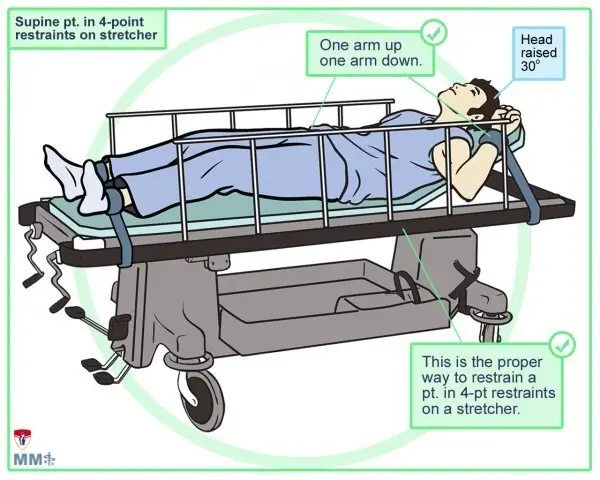
Proper Techniques to Restrain a Patient

Use the following techniques when left with no other option but to restrain the patient physically and/or chemically:

  • Restrain the limbs with one arm above and one arm below the knee;
  • Have one person for each limb;
  • One person with airway skills controls the head;
  • One person administers pre-prepared medications;
  • With the patient supine, apply restraints securely to each extremity;
  • Use medical grade restraints secured to the bed frame (NOT side rails);
  • Always explain to the patient what is happening.

Restraint documentation

In your documentation, explain the reason for the restraint and list any alternative therapies you attempted as well as an assessment of potential injuries or complications. Also, describe your monitoring plan, thresholds for further interventions, and ongoing sedation options and a sedation chart.

Chemical restraints

The use of chemical restraints is a staple of major importance in the ED physician’s arsenal against violence in the ED. It is important that the medication properly fit the etiology of the violence-inducing illness. Ketamine has shown to be a useful tool in non-schizophrenic patients and has the quickest onset of action. When combined with a calming medication, Ketamine can reduce the danger in a matter of a few minutes. The following table lists common medications used by illness etiology.
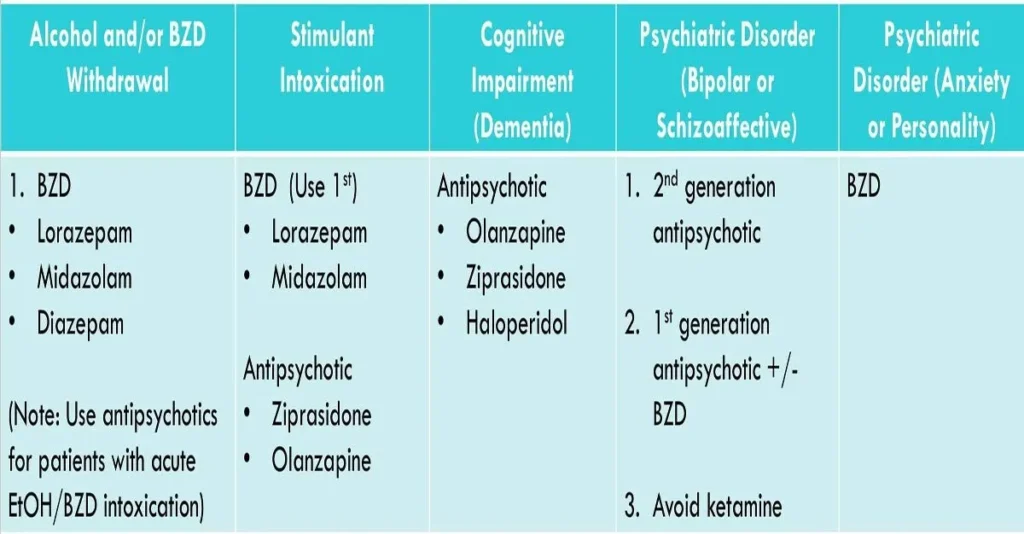
Most importantly, it is pivotal that patients receiving chemical sedation get the appropriate monitoring to avoid harm from the treatment.

Key takeaways

ED patients who are agitated, violent, or psychotic and not only a danger to themselves but also those around them. The takedown can be a useful way to manage violent episodes when properly applied by the appropriate number of well-equipped, trained staff.

The key to violence prevention, particularly as it applies to physical or chemical restraint, is preparation. That includes proper training, having adequate supplies, and plenty of staff available to assist.

Make it an imperative that you will not physically restrain a patient without appropriate support (the six-person minimum).

Use chemical restraint when necessary but only when it’s safe to do so and choose the best option possible given the patient’s disposition. Then, carefully monitor chemical sedation to ensure the patient’s wellbeing.

This post was written as part of a 3-part blog post series called Violence in the ED. 
Part 1: Violence in the Emergency Department Is On the Rise, But Why?
Part 2: Violence in the Emergency Department: 7 Steps to Ensure a Safer Workplace

  • clinician satisfaction, Emergency Medicine, Industry insights, mental health and well-being
Facebook Linkedin

Related Blogs

resident physician smiles at camera with other residents in background

How to support clinicians in their first year post-residency

male doctor talking to patient over headset in front of computer

Technology at the front door – The benefits of virtual triage in the ED

female doctor looking at a tablet

Five spheres of clinician impact

Subscribe to our Newsletter

Sign up for our newsletter to receive the latest updates and exclusive content straight to your inbox.

A physician-led team of clinical specialists in emergency, hospital, and critical care medicine, supporting local clinical practices with national resources to deliver high-quality patient care in the communities we serve.

Corporate Phone: (800) 893-9698

Facebook-f Linkedin Youtube

Useful Links

  • SCP Clinician Portal
  • Insurance Request Portal
  • Corporate Compliance
  • Privacy Policy
  • Terms of Use

Contact Interest

  • Billing Questions
  • Clinical Career Opportunities
  • Clinical Services Inquiry
  • Corporate Career Opportunities
  • Employee & Clinician Verification
  • Contact Us

Trending Posts

  • A Clinician's Guide to Evaluating Leadership
  • Four Reasons Why Documentation is Important
  • The Importance of Values in Health Care
  • Social Networks for Doctors
Also of Interest
  • Violence in the Emergency Department: 7 Steps...
  • Violence in the Emergency Department Is On the...
  • How to promote healthy conflict resolution in...

Copyright © 2025. All rights reserved.

Insurance Request Portal

Please visit SCP Health’s Insurance Request Portal to submit requests related to medical malpractice liability insurance such as coverage verifications, claims history reports, and certificates of insurance. If you experience issues with the portal submission or have a question about the process, please reach out SCP Health’s Risk Management, Safety and Insurance Department at RM@scphealth.com or 337-609-1250.

Insurance Request Portal Illustrative Instructions

Access Portal
Questions About Your Bill?

By clicking the “Submit” button, you are agreeing to the SCP Heath Terms of Use and Privacy Policy

Start Your Clinical Career Conversation

By clicking the “Submit” button, you are agreeing to the SCP Heath Terms of Use and Privacy Policy

Explore Our Clinical Services

By clicking the “Submit” button, you are agreeing to the SCP Heath Terms of Use and Privacy Policy

Learn More About Corporate Careers

By clicking the “Submit” button, you are agreeing to the SCP Heath Terms of Use and Privacy Policy

Employee Verification Request
By clicking the “Submit” button, you are agreeing to the SCP Heath Terms of Use and Privacy Policy

Attend our
After-Hours CME Event

Date: Tuesday, March 31, 2026
Time: 6:00 PM – 9:00 PM
Location: Harriett’s Rooftop Bar

By clicking the “Submit” button, you are agreeing to the SCP Heath Terms of Use and Privacy Policy

Get in Touch

By clicking the “Submit” button, you are agreeing to the SCP Heath Terms of Use and Privacy Policy

Looking forward to connecting

By clicking the “Submit” button, you are agreeing to the SCP Heath Terms of Use and Privacy Policy

Join Our Clinician Community

Insights, updates, and resources created for clinicians.

By clicking the “Submit” button, you are agreeing to the SCP Heath Terms of Use and Privacy Policy

Access Leadership Insights

By clicking the “Submit” button, you are agreeing to the SCP Heath Terms of Use and Privacy Policy
Advocacy Interest

By clicking the “Submit” button, you are agreeing to the SCP Heath Terms of Use and Privacy Policy

Employment Verification Request

By clicking the “Submit” button, you are agreeing to the SCP Heath Terms of Use and Privacy Policy

Request for Medical Records

By clicking the “Submit” button, you are agreeing to the SCP Heath Terms of Use and Privacy Policy

Explore Integrated Clinical Solutions
By clicking the “Submit” button, you are agreeing to the SCP Heath Terms of Use and Privacy Policy
Explore Our Core Capabilities
By clicking the “Submit” button, you are agreeing to the SCP Heath Terms of Use and Privacy Policy
Let’s Start a Conversation

By clicking the “Submit” button, you are agreeing to the SCP Heath Terms of Use and Privacy Policy

Insurance Request

By clicking the “Submit” button, you are agreeing to the SCP Heath Terms of Use and Privacy Policy

Questions?
We’re Here to Help
By clicking the “Submit” button, you are agreeing to the SCP Heath Terms of Use and Privacy Policy
Hospital at Home for Health Care Leaders
By clicking the “Submit” button, you are agreeing to the SCP Heath Terms of Use and Privacy Policy
Explore SCP Connected Care
By clicking the “Submit” button, you are agreeing to the SCP Heath Terms of Use and Privacy Policy
Explore Critical Care Solutions
By clicking the “Submit” button, you are agreeing to the SCP Heath Terms of Use and Privacy Policy
Explore Hospital Medicine Solutions
By clicking the “Submit” button, you are agreeing to the SCP Heath Terms of Use and Privacy Policy
Explore Emergency Medicine Solutions
By clicking the “Submit” button, you are agreeing to the SCP Heath Terms of Use and Privacy Policy
Contact Information

Please provide your contact information. An SCP representative will contact you accordingly.

Apply To Job
Apply to Job
By clicking the “Submit” button, you are agreeing to the SCP Heath Terms of Use and Privacy Policy